THE UAP MAP
Stephenville–Dublin · Texas · 8 January 2008

The F-16s
were there.The correlation
is the case.

Witnesses reported unusual lights and apparent structure. The Air Force later corrected its first answer and acknowledged F-16 activity in the vicinity. Archived radar was subsequently analysed. The hard question is whether any of those records describe the same thing.

witness reportsF-16 activity correctedradar archive analysedcorrelation unresolved
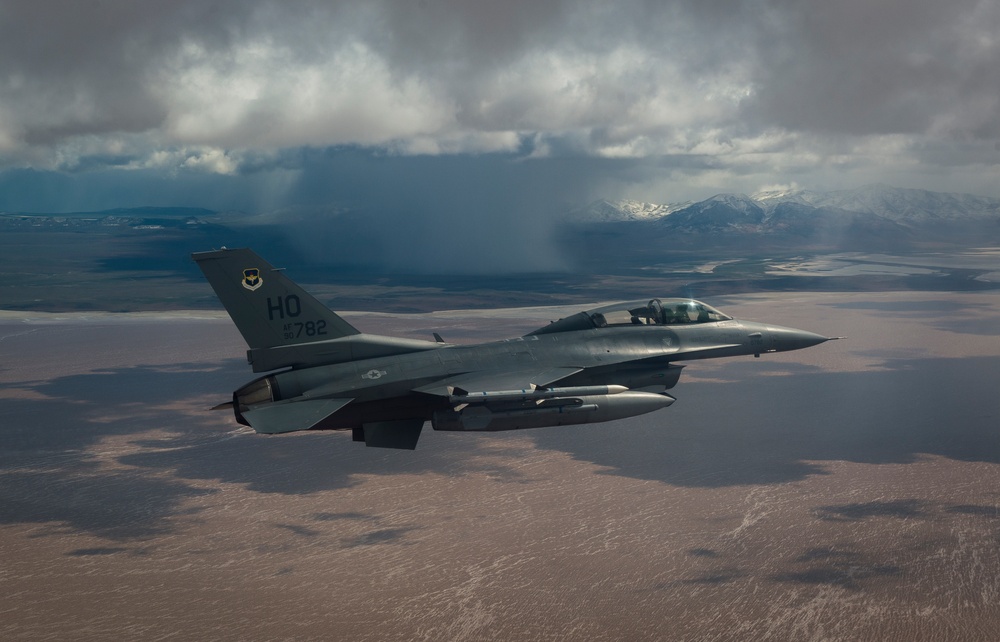
A U.S. Air Force F-16D in flight during a 2017 training mission over Utah
CONTEXT IMAGE, NOT STEPHENVILLE. U.S. Air Force F-16D during training over Utah, 17 May 2017. Staff Sgt. Andrew Lee / DVIDS; public domain. It does not depict Texas, 2008, the reported sighting or aircraft involved that night.
READ THIS CASE CORRECTLYThe later acknowledgement of F-16 activity confirms aircraft were present; it does not independently verify a pursuit or identify a reported object. A radar return is not automatically the object a witness believed they saw.
01 / two records

One witness field.
Several different evidence types.

Stephenville is not one clean sighting with one clean data trail. It is a collection of testimony, a documented correction about military activity, archived radar material and later technical interpretation. Each can matter without proving the others.

Witness testimony

What people said they saw

Residents in and around Stephenville and Dublin described bright lights and, in some accounts, a very large or structured object. The reports belong to their observers. They establish that a substantial public witness wave occurred; they do not create an independently measured object by themselves.

Documented military activity

What the correction establishes

NPR recorded the Air Force’s change from an initial denial to an acknowledgement that nearly a dozen F-16s were in the vicinity that evening. It establishes relevant aircraft activity, not that those aircraft were chasing an anomalous target.

Archived radar material

What data makes possible

Radar material gives investigators a traffic record that can be compared against reports after the event. It cannot identify a visual object unless timing, location, direction and the characteristics of a particular track align closely enough.

Later technical analysis

What investigators concluded

MUFON and later SCU-associated work examined the material. Those reports are analytical interpretations, not an FAA finding that an extraordinary object was tracked or that every unlabelled return was anomalous.

02 / confirmed activity

The answer changed.
The pursuit did not become confirmed.

8 JAN 2008

Reports spread

Witness accounts emerged from the Stephenville–Dublin area. Their descriptions were not identical, and the page does not collapse them into a single perfectly observed object.

INITIAL RESPONSE

No relevant fighters

Contemporary reporting records an initial military response that denied fighter activity in the area. That early answer became part of the case because it was later corrected.

LATER CORRECTION

F-16 activity acknowledged

NPR reported that the Air Force said nearly a dozen F-16s had been in the vicinity and attributed the earlier response to a communications error. This is the firmest official-adjacent record on the page.

REMAINING GAP

No verified chase

The same NPR report says the spokesman knew of no unusual pilot reports and understood that the pilots had not been interviewed. The public record therefore does not independently establish a fighter pursuit of an unidentified object.

Document reading rule

Presence is not a match.

Known F-16 activity belongs in any serious reconstruction. It can explain some observations or tracks only where the timing and geography actually fit. Its existence cannot be used as a blanket explanation for every report.

Confirmed

F-16 activity was acknowledged after the initial denial. This corrects the public record of aircraft presence.

Reported

Witnesses described fighters in relation to a larger lighted object. This is testimony, not a pilot, sensor or command-record confirmation of a chase.

Open

Which witnesses saw which aircraft, and whether specific aircraft tracks align with specific observations. Those are correlation questions, not settled by the acknowledgement alone.

03 / the data problem

Radar gave the case
a file—not a verdict.

The important visual record is documentary, not a decorative radar screen. This briefing does not recreate a plot, draw a flight path or use a fabricated glowing return. The evidential task is to test named observations against dated traffic data.

What survives publicly

A basis for analysis

The SCU publication page describes a review of witness testimony and radar data from five different radar sites. That makes the event more testable than a witness-only case.

What the review is

An investigator report

The study’s conclusions are those of its authors, Glen Schulze and Robert Powell. They should not be restated as an FAA conclusion or as an official identification of a single unknown craft.

What radar can show

Traffic in place and time

A track may support the existence and movement of an observed return. It does not, on its own, establish shape, size, intention, origin or a link to a particular witness description.

The required test

Correlation, not spectacle

The strongest claim must meet the strongest standard: a specific witness account, a specific time window, a specific location and direction, and a specific relevant track—plus a defensible exclusion of ordinary traffic or artefact.

“Radar data” is not a conclusion. It is a constraint: any explanation has to account for the records that can actually be tied to the right place, time and observation.
04 / what the record supports

Interesting evidence.
Uneven linkage.

Record element
What it supports
What it does not settle
Witness reports
A broad wave of attributed reports from the Stephenville–Dublin area.
One shared object, an objective size, distance or a non-conventional cause.
F-16 correction
Relevant military aircraft activity was present after an initial inaccurate public answer.
That fighters pursued an anomalous object, or that they account for every sighting.
Archived radar analysis
A route to compare air traffic records with particular testimony.
That a particular return was the object described by a particular witness.
MUFON / SCU studies
Named investigators examined the material and presented interpretations.
An FAA or military finding that an extraordinary craft was identified.
Evidence limit

The visual reports, the F-16 correction and the radar analyses can all be genuine parts of the same night while not all referring to the same object. The unresolved issue is whether the strongest strands can be matched tightly enough to justify a shared explanation.

Media reference: Stephenville F-16 training image (case file asset)