MATRIARCH
Glennie Lankford
The household matriarch and one of the most important adult witnesses. Her later account was treated seriously by investigators and she consistently rejected the idea that the family had been drinking.
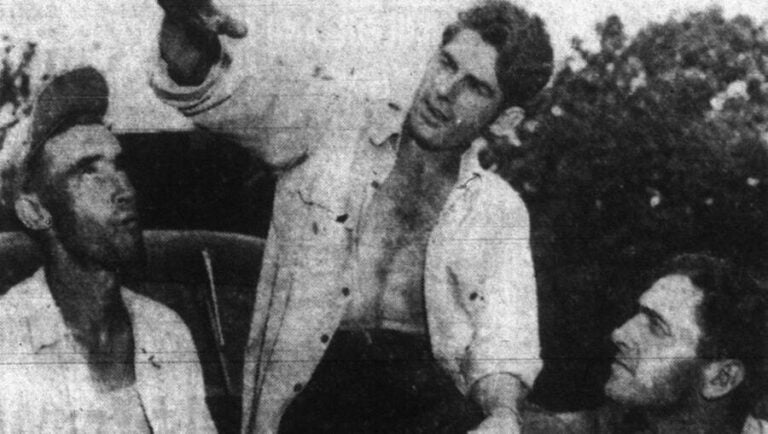
Kelly–Hopkinsville is one of those UFO stories that sounds too theatrical to be useful—until you strip the legend back to 1955. Multiple adults said they saw small figures. The household abandoned the farm and went to police that same night. Officers, deputies, state troopers and military police then searched the property. And the next day, adults were interviewed separately while the story was still fresh.
The story began around dusk at the Sutton farmhouse near Kelly, north of Hopkinsville. Billy Ray Taylor went outside for water. He later said he saw a bright object move across the sky and descend beyond the property, toward a low area or gully.
Inside the farmhouse were members of the Sutton and Taylor families, adults and children sharing an ordinary summer evening. Taylor’s story did not immediately turn the house into a UFO command post. It was reportedly doubted or brushed aside. That matters because the later encounter was not simply the product of everyone rushing outside expecting aliens the moment he came through the door.
A meteor is a serious explanation for Taylor’s original descending light. Contemporary reports describe meteor-like activity in the region that night. If that is correct, the first part of the case may be perfectly ordinary—and may also explain why the household was primed to interpret later ambiguous sights as connected to something that had just “landed”.
Accounts place the first close encounter later in the evening. The dog became disturbed. Taylor and Elmer “Lucky” Sutton went outside with firearms and reported seeing a small figure approaching from the darkness.
The famous description was not of a conventional 1950s saucer pilot. Witnesses spoke of something roughly three feet tall, with an oversized head, large luminous-looking eyes, ears that projected upward or outward, very long arms and claw-like hands. Its movement was the strangest part: witnesses said it seemed to float, glide or drop unusually slowly when shot at.
The men fired. Whatever they believed they were shooting at disappeared into the darkness. Then another figure was reported. Then another appearance at a window. The encounter became repetitive rather than singular.
The Sutton account describes the figures reappearing around the property for hours. One was reportedly seen peering through a window. Another appeared near the roof or overhang. A figure in a tree was fired upon and seemed to descend slowly rather than fall normally.
Gunfire became a central part of the night. That is evidentially awkward. On one hand, the family’s decision to fire repeatedly shows how real the threat felt to them. On the other, muzzle flash, darkness, noise, fear and people scanning different windows create terrible conditions for accurate perception.
The reported beings were never said to force entry. They did not drag anyone away. They did not leave behind a body when struck. The witnesses instead described them as repeatedly approaching, peering and withdrawing—a pattern that helps explain why the encounter has remained so visually distinctive.
At around 11 p.m., the family did something that created a contemporary record: they left the farmhouse and drove to Hopkinsville police headquarters. The next day’s Kentucky New Era reported that multiple adults and children arrived highly excited and that officers responded to the property.
The responding force was unusually large for a rural UFO report. Hopkinsville police were joined by state troopers, sheriff’s deputies and military police from nearby Fort Campbell. The search lasted into the early morning.
They found no spacecraft. They found no dead “goblin”. They found no trackway that could be tied to an unknown being. Contemporary reporting did note physical evidence of the occupants’ own response, including a hole in a screen where a shot had been fired. In other words: the shooting was real. What the shooting was directed at remains the disputed part.
The witness structure is one reason researchers have continued to return to Kelly. These were not independent observers scattered across a county; they were relatives and friends inside the same house, exposed to one another’s reactions. That limits independence. But the number of people involved also makes a simple one-person fabrication less satisfying.
The household matriarch and one of the most important adult witnesses. Her later account was treated seriously by investigators and she consistently rejected the idea that the family had been drinking.
The men most closely associated with the first close sightings and much of the gunfire. Taylor also supplied the original report of the descending aerial light.
Interviewed adult witnesses the next day and produced drawings from their descriptions. Those near-contemporary interviews are among the case’s most valuable surviving elements.
Later investigator Isabel Davis reconstructed the case in detail using early material. The research record notes substantial agreement among the adult witnesses while also preserving differences in specific facial and anatomical details.
Popular culture flattened Kelly into a phrase. The early descriptions were stranger. Witnesses spoke of small, pale, silvery or luminous-looking figures with large glowing eyes, oversized ears, thin legs, long arms and broad clawed hands. “Little green men” is a later cultural label, not an accurate summary of the first descriptions.
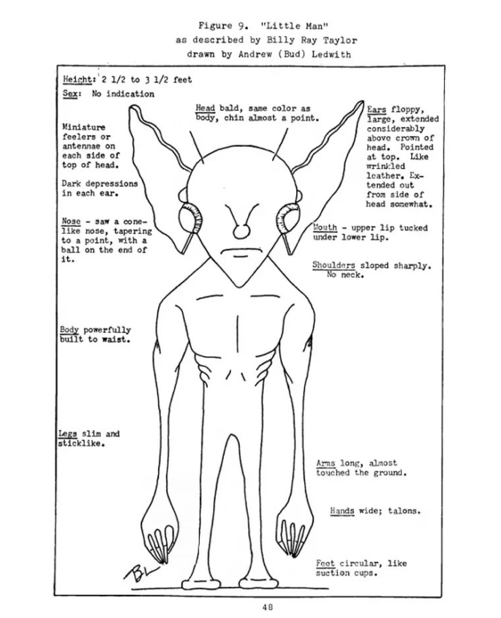
The drawing matters because it gives shape to near-contemporary witness testimony. It also exposes how variable human description can be. Some versions emphasise a nearly round head and enormous ears; others add a more pronounced nose or different proportions.
The useful question is not “does this drawing prove an alien?” It is “how much of the unusual morphology appears consistently across early accounts, and how much entered through later retelling?”
The household went to police during the night rather than waiting years to tell the story.
Several adults reported overlapping elements, though they were related, together and not fully independent.
A substantial law-enforcement search is part of the contemporary record. No unknown entity was found.
No body, craft, photograph, biological sample or sensor record establishes what the witnesses saw.
This is why the case earns a mid-range evidence score rather than Tier 1 status. The event is well anchored historically. The extraordinary interpretation is not anchored physically.
The strongest conventional explanation does not dismiss the witnesses as fools. It asks whether frightened people, already primed by a descending light, repeatedly encountered large nocturnal birds around a dark farmhouse.
Great horned owls can have huge forward-facing eyes that shine intensely under direct light. Ear tufts can exaggerate the shape of the head. Their wings can create the impression of long arms. They move silently, perch close to houses and can behave defensively near nests. A bird dropping from a branch can also appear to float for a moment rather than fall.
Put those features into darkness, add firearms, screaming children, repeated scanning of trees and windows, and the hypothesis becomes much stronger than a joke about “people mistaking an owl for an alien”.
A deliberate hoax has always been possible in principle. But it requires explaining why a relatively poor rural household would involve numerous relatives and children, fire live ammunition through parts of their own home, race to police, invite a major official response and then remain attached to a story that brought ridicule as well as curiosity seekers.
That does not make fraud impossible. Nor does apparent sincerity prove an extraordinary cause. A different model may fit better: one or two ambiguous stimuli were misidentified, the household’s fear became mutually reinforcing, and every later rustle, eye-shine or movement around the house was interpreted through the frame of “the things are back”.
This kind of escalating feedback could preserve genuine fear without requiring either conscious deception or non-human visitors.
The Kelly–Hopkinsville case is not strong because bullets bounced off aliens. That part rests entirely on witness testimony. It is strong because the encounter entered the record immediately, generated a substantial police response, and was followed by near-contemporary interviews rather than being reconstructed for the first time decades later.
The owl-and-meteor hypothesis is serious. In fact, it may explain a great deal: the initial aerial light, the glowing eyes, pointed head profile, tree and roofline appearances, strange gliding movement and the lack of physical remains. Excitement and repeated gunfire could have done the rest.
But “plausible” is not the same as “demonstrated”. No one caught an owl at the window. No investigator reconstructed every sighting from a known animal at a known perch. And several adults continued to describe something far stranger than a bird.
The UAP Map therefore treats Kelly as a well-documented but strongly disputed humanoid encounter. Its value is not that it proves visitors from somewhere else. Its value is that, after removing the “little green men” caricature, there remains a real night, real witnesses, real gunfire, real police involvement—and an identity that was never physically established.
Do you have an original 1955 newspaper page, police document, Ledwith/Davis interview material, family photograph, farmhouse image or provenance information for the early drawings? The UAP Map keeps this case open to better primary material.
On the night of 21 August 1955, members of the Sutton and Lankford families reported seeing strange figures near a farmhouse outside Kelly, Kentucky. The witnesses described repeated approaches to the house, gunfire, and an encounter that continued for hours. They eventually sought help from local authorities, who found no confirmed intruders or physical explanation for the reported visitors.
The case is unusually rich in immediate testimony because several people were present and because the family contacted police. It is also vulnerable to ordinary explanations: owls, animals, reflections, fear, alcohol, and group excitement have all been proposed. The reported figures were not captured or photographed, and the later “goblin” image became more fixed than the original testimony.
The most defensible description is a prolonged family encounter report with a documented police response and no settled object identification. Kelly–Hopkinsville matters as a study in group perception and folklore as much as it does as a claimed close encounter.
A family member reports a strange figure near the farmhouse, beginning a night of repeated alarms.
Witnesses say figures return to the house and are fired upon. The accounts vary in detail but share a prolonged, frightening setting.
The family seeks help from authorities. Officers inspect the property but do not find a confirmed intruder or physical explanation.
Newspaper coverage and later popular culture turn the encounter into the “Hopkinsville goblins” story.
Compare with Flatwoods for another 1950s rural encounter transformed by press coverage and later illustration.