THE CLAIM BEGINS
The children report the first apparition at Cova da Iria.
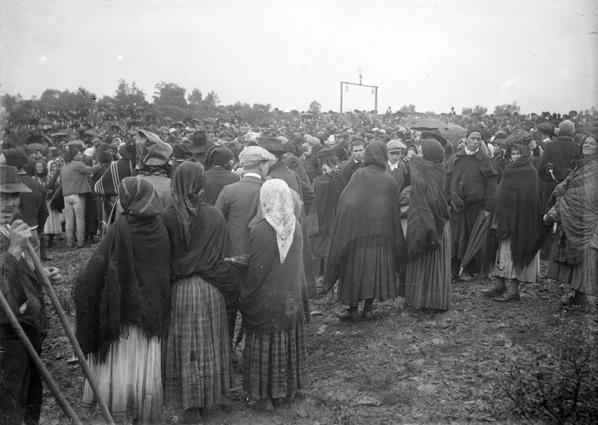
Months of claims by three shepherd children drew an enormous crowd into a rain-soaked field. What happened next became known as the Miracle of the Sun — a mass-witness event recorded in contemporary newspapers, preserved in period photographs, and interpreted ever since as miracle, optical phenomenon, crowd event or something stranger.
Fátima began with three children: Lúcia dos Santos and her cousins Francisco and Jacinta Marto. From May 1917 they reported recurring encounters with a radiant female figure at Cova da Iria.
The claims did not stay private. Family, clergy, local officials, journalists, believers and critics entered the story. The children were questioned repeatedly. In August they were detained by the local civil administrator. Attendance at the monthly gatherings grew.
By October, something crucial had changed. The event was no longer only about whether three children were telling the truth. A large public had arrived expecting that something observable would happen.
The children report the first apparition at Cova da Iria.
More people attend; the children remain the central witnesses.
Later history makes July central, but the exact content of the “secrets” must be source-dated carefully.
The children are taken and questioned by civil administrator Artur de Oliveira Santos.
Attendance increases and an October culmination is anticipated.
Tens of thousands gather in heavy rain for the promised public sign.

The three children are inseparable from the event, but not equally represented in the historical record. Francisco and Jacinta died young. Lúcia lived until 2005 and became the principal later custodian of the apparition story.
That creates an evidential problem and an opportunity. Early testimony can be compared with Lúcia’s later memoirs to see what was present near the event and what emerged after years of interpretation, religious formation and institutional history.
Newspapers, photographs, interrogations, local records and testimony produced during or immediately around the events.
Early church inquiry material and testimony recorded before the mature devotional narrative was fully established.
Much richer detail appears in later memoirs. These documents are historically important but cannot be silently backdated into 1917.
Later clergy, biographers, sceptics and UFO writers selected different parts of the story and sometimes enlarged them.

Contemporary accounts describe a wet, muddy gathering and a subsequent visual event involving the Sun or a sun-like disc. Reports differ in detail: colour changes, apparent rotation, movement, descent or a threatening approach appear in different tellings.
Not every person reported the same thing, and crowd-size estimates vary substantially. The strongest historical question is therefore not “Did 70,000 people see exactly the same miracle?” It is “What visual effects were independently reported, by whom, and how close to 13 October were those reports recorded?”
Rain, cloud breaks, solar altitude, viewing direction and duration are not side issues. They are the physical conditions against which optical, atmospheric and astronomical explanations must be tested. The existing Fátima research correctly identifies a date-specific weather and visual-conditions reconstruction as one of the most valuable remaining analytical projects.
Mass-witness cases are deceptively difficult. People stand in different places, look at different moments, describe unfamiliar visual effects with different vocabularies and influence one another before, during and after the event.
That does not make the testimony worthless. It means the evidence should be treated as a corpus rather than as a single unanimous statement.
Some witnesses described dramatic motion, rotation, colour or apparent descent. These accounts created the enduring “Miracle of the Sun” image.
Other observers reported unusual solar appearance or atmospheric effects without every dramatic feature found in later summaries.
Negative, ambiguous and less dramatic testimony is analytically important and should not be removed to create artificial unanimity.
The Catholic interpretation places the October phenomenon inside the six-month apparition sequence and the children’s religious message. The eventual Church judgement concerns the apparition tradition, not a laboratory measurement of the Sun.
Later UFO writers, including Jacques Vallée and others, have treated Fátima as an anomalous-phenomena case. That interpretation is worth tracing historically — but only after determining which aerial-object details are genuinely contemporary and which entered later.
Optical and physiological explanations — including prolonged solar viewing and retinal effects — can plausibly explain some reported colour, apparent motion and after-images. Atmospheric conditions may also have contributed.
But any explanation must engage the diversity of testimony rather than a simplified “everyone saw the Sun dance” version. And a UAP explanation faces the same standard: it cannot use later language about discs, globes or aerial craft unless that language can be traced to early sources.
Francisco and Jacinta died within a few years of the events. Lúcia survived for almost nine more decades. As a result, some of the most famous elements of the Fátima story reached the world through a single surviving participant writing under very different circumstances from those of 1917.
The “secrets,” references to Russia, the vision of Hell and other famous components therefore need their own dated histories. Their importance to Catholic devotion is not in question. Their evidential relationship to what was documented in 1917 is a separate historical problem.
For The UAP Map, that distinction is invaluable. Fátima becomes a case study in how extraordinary events acquire layers: immediate experience, contemporary reporting, institutional inquiry, memory, doctrine, popular culture and later anomalous interpretation.
Fátima is unusually rich in archives. The highest-value contribution is not another retelling — it is an earlier document, original-language quotation, photograph provenance correction or independently dated witness account.
Fátima is not a conventional UFO case. It is something more difficult: a historical mass-witness event embedded inside religion, politics, journalism, childhood testimony and later institutional memory.
The photographs establish that a very large crowd gathered at Cova da Iria on 13 October 1917. Contemporary newspapers establish that unusual solar phenomena were reported. The children’s claims predated the mass gathering and created the expectation that drew people there.
What the record does not establish is that every person saw the same thing, that the physical Sun moved, or that a technological object was present.
Optical, physiological and atmospheric explanations may account for important portions of the testimony. Religious interpretation supplies the event’s historical meaning for millions of believers. Later UAP interpretations raise legitimate comparative questions, but they must not import later vocabulary into the 1917 record.
The enduring mystery is therefore not merely “What made the Sun dance?”
It is how a promised event, witnessed by a vast crowd under difficult weather conditions, generated a body of testimony strong enough to survive a century — yet diverse enough that no single physical reconstruction has closed the case.
The October 1917 event at Cova da Iria is often reduced to a single miraculous image. The historical record is more layered: the three shepherd children’s earlier reports, the crowds who gathered on 13 October, the weather and light conditions, newspaper accounts, and the later religious and cultural interpretations of what became known as the “Miracle of the Sun.”
Lucia dos Santos and her cousins Francisco and Jacinta Marto were the principal witnesses who reported visions in the months before October. On 13 October, a large crowd assembled after the public prediction of a sign. Many witnesses described unusual changes in the sun’s appearance or the movement of light, while others reported only rain, clouds, or no extraordinary phenomenon.
The event’s evidential value therefore depends on separating direct testimony from later theological interpretation. The crowd testimony makes Fatima historically important; it does not, by itself, establish a single physical mechanism for what people saw.
The children report recurring visions at Cova da Iria. The accounts attract local attention and gradually broaden the expected audience.
A large crowd assembles after the public prediction of a sign. Weather conditions and witness position vary across later accounts.
Newspaper reports preserve a mixture of direct testimony, second-hand claims, and editorial framing.
The event becomes a major religious and cultural tradition, with later narratives shaping how the original reports are remembered.
Compare with Ariel School and Westall — two other mass-witness records where testimony, context and later interpretation must be kept separate.
For a later school encounter where drawings and early interviews became central, read Ariel School.
Fátima is not a conventional UFO case but a historical mass-witness event embedded inside religion, politics, journalism, childhood testimony and later institutional memory. The photographs establish that a very large crowd gathered at Cova da Iria on 13 October 1917, and contemporary newspapers establish that unusual solar phenomena were reported. The analytical importance lies in keeping the evidential layers separate — the contemporary 1917 record, the early retrospective layer, Lúcia's later memoirs, and the later devotional and UAP retellings — and in recognising that no single physical reconstruction has closed the case, while no UAP interpretation can simply inherit every later devotional detail as contemporary evidence.
1917 Portuguese newspaper reporting and early interrogations of the children · Period photographs of the 13 October 1917 gathering (Sanctuary of Fátima archive; Judah Bento Ruah, Ilustração Portugueza) · Lúcia dos Santos' later memoirs and the evolving devotional record · The UAP Map master research archive