The diamond
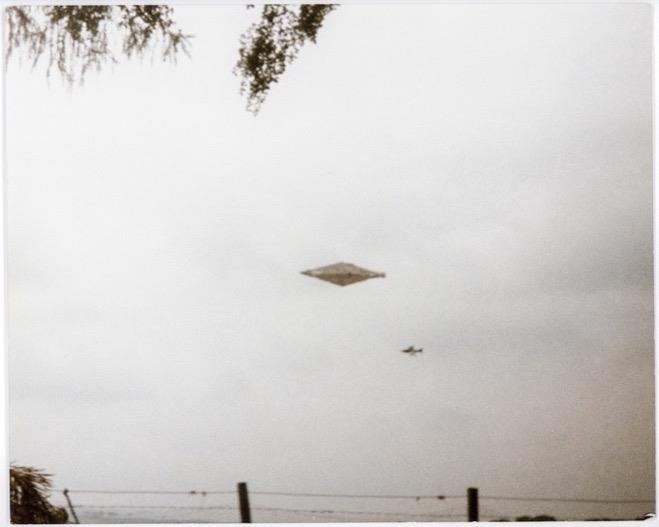
The central form has a hard, faceted outline and remains visible within the full print. Grain continues through the image, but the print cannot provide a reliable distance or physical scale.
CALVINE · PERTHSHIRE · 4 AUGUST 1990
The image that survived. The five frames that did not. A photograph-first investigation of the Calvine case.
01 / THE PHOTOGRAPH
The public image is a black-and-white 10×8 print, not the original colour negative. Craig Lindsay, an RAF press officer who handled the case material, retained the print and associated papers before donating them to Sheffield Hallam University. Photographic analysis can examine the print’s physical continuity and grain; it cannot recover distance, size, identity or origin from the image alone.
DOCUMENTED BOUNDARY: a photograph may be genuine without proving what the photographed object was.

02 / THE ENCOUNTER
According to the summary that reached the Ministry of Defence, two men near Calvine reported a large diamond-shaped object that appeared stationary for approximately ten minutes. A military jet passed nearby and was later assessed as consistent with a Harrier. The men reportedly took six colour photographs.
The contemporary record is narrower than later retellings. The exact camera position, the witnesses’ identities, the aircraft’s flight record and the full original photographic sequence remain unresolved.
03 / FIVE FRAMES MISSING
Six photographs were reported. One print emerged decades later. The other five frames, the original negatives, and the complete photographic sequence are not publicly available. We should not invent what they showed. We can identify what their absence prevents us from testing.
ABSENCE IS NOT PROOF: the missing frames are an evidential limit, not evidence of a cover-up by themselves.
04 / EXAMINE THE PRINT
The central form has a hard, faceted outline and remains visible within the full print. Grain continues through the image, but the print cannot provide a reliable distance or physical scale.
A small aircraft appears below and to the right of the object. Its presence gives the image a possible scale reference, but the separation and distance are not independently measured.
Fence posts, branches and the horizon are part of the original visual context. Cropping them away would remove the very evidence needed for cautious analysis.
INTERPRETATION BOUNDARY: photographic continuity can argue against a simple pasted addition; it cannot exclude a physical model, ornament, reflection or other staged object.
05 / THE HARRIER
The aircraft in the photograph has been assessed as consistent with a Harrier. That does not establish which aircraft it was, who flew it, or whether the pilot saw the object. The official and photographic records do not provide a complete flight log that resolves the relationship.

06 / EXPLANATIONS
A suspended model, reflection, cloud or mountain feature, unfamiliar aircraft, or a deliberately staged scene have all been proposed. Each must account for the full surviving print, the aircraft, the reported six-frame sequence, the chain of custody and the missing witnesses.
The responsible conclusion is narrower: the print is a real object in the public record, but the image alone does not establish what the object was or whether the event occurred exactly as later retellings describe it.
07 / WHAT WOULD CHANGE THE CASE
The full sequence and original photographic material would allow stronger testing of motion, scale and continuity.
Verified first-hand testimony would clarify location, sequence, camera handling and what was observed before and after the photograph.
Complete RAF, MoD, newspaper and archival records could test the aircraft and chain-of-custody questions.
SOURCE ROOM